
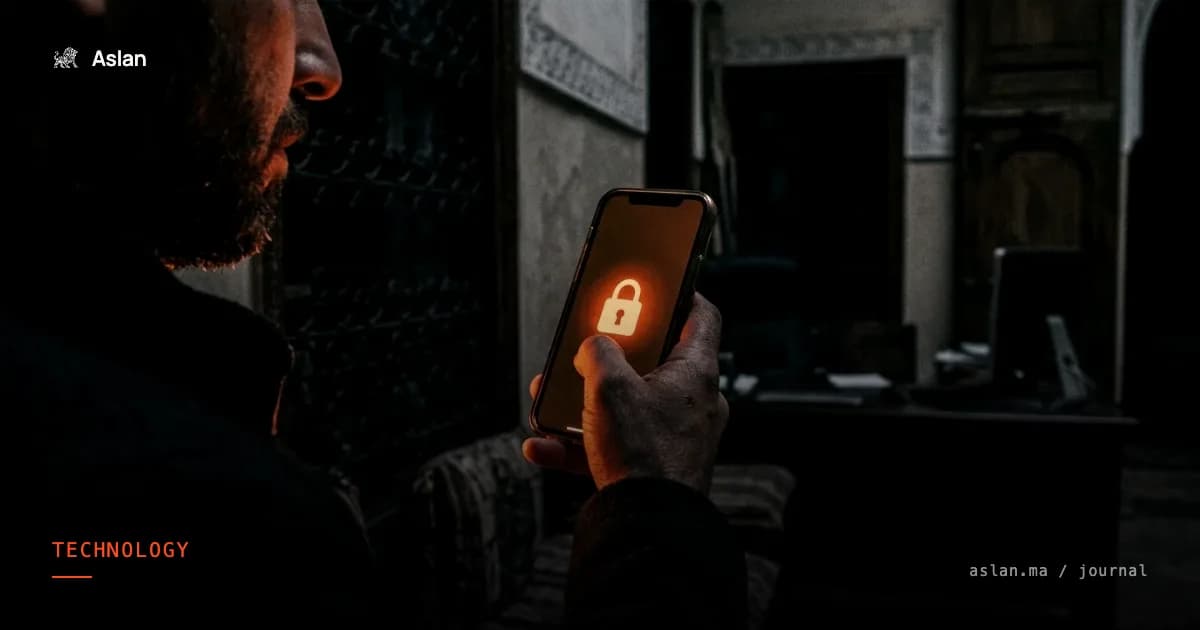
Security: The Foundation of Trust in Digital Banking
In a world where cyberattacks against financial institutions increase by 38% annually, security is not just a marketing argument — it is the very foundation of trust between a financial platform and its users.
In Morocco, where digital banking adoption is accelerating, entrepreneurs legitimately ask: "Are my financial data truly safe on a mobile application?" This is a question we answer with transparency at Aslan.
This article explains, in accessible language, the different layers of protection we deploy to secure your data and transactions.
Encryption: Your Digital Vault
What Is Encryption?
Imagine sending a letter. Encryption is like transforming that letter into an unbreakable code before sending it. Only the recipient has the key to decode it. Even if someone intercepts the message, they will only see incomprehensible characters.
How Aslan Encrypts Your Data
At Aslan, we use several levels of encryption:
- Encryption in transit (TLS 1.3): All communications between your phone and our servers are encrypted with TLS 1.3, the most recent and secure standard. Think of it as an armored tunnel between you and us.
- Encryption at rest (AES-256): Your data stored on our servers is encrypted with AES-256, the same standard used by governments and militaries worldwide. It would take a supercomputer billions of years to break this encryption.
- End-to-end encryption: For the most sensitive data (ID numbers, personal information), we apply end-to-end encryption. Even our own technical teams cannot access this data in cleartext.
"AES-256 encryption is considered mathematically unbreakable with current technology. It is the same protection standard used by the world's largest banks."
Zero Trust Architecture: Trust No One
The Concept Simply Explained
In a physical bank, you show your ID at the entrance, then move freely. Zero Trust architecture works differently: every door, every counter, every vault asks you to prove your identity again. Nothing is assumed safe.
Concretely, at Aslan this means:
- Every request is verified: Whether coming from inside or outside our network, it is individually authenticated and authorized
- Least privilege principle: Each component in our system only accesses data strictly necessary for its function
- Network segmentation: Our systems are compartmentalized. Even if an attacker breached one zone, they couldn't access others
- Continuous monitoring: Every activity is monitored in real-time, 24/7
Why It Matters to You
Zero Trust architecture is particularly relevant in the Moroccan context, where many users access their banking services from public WiFi networks (cafes, shopping malls). With our architecture, even if you connect from an unsecured network, your data stays protected at every step.
Multi-Factor Authentication (2FA): Double Verification
Beyond the Simple Password
A password alone is no longer sufficient to protect a financial account. Multi-factor authentication combines several verification elements:
- Something you know: Your PIN code or password
- Something you have: Your phone (which receives a unique OTP code)
- Something you are: Your fingerprint or face (biometrics)
How It Works at Aslan
Here are the authentication layers we use:
- 4-digit PIN: For routine operations (balance checks, history)
- SMS OTP: A unique 6-digit code sent to your phone for sensitive operations (transfers, profile changes)
- Biometrics: Fingerprint or facial recognition for quick and secure app access
- Device verification: We uniquely identify your device. If a login is attempted from an unknown device, additional checks are triggered
Biometric Authentication: Your Body as Your Key
Biometrics represents the future of banking authentication. Instead of remembering a complex password, your body becomes your identifier:
- Fingerprint: The fastest method, available on most smartphones in Morocco
- Facial recognition: Uses your phone's camera to verify your identity in a fraction of a second
This biometric data never leaves your phone. They are stored in a secure area of your device (the Secure Enclave on iPhone or equivalent on Android) and are never transmitted to our servers.
Real-Time Fraud Detection
How Aslan Detects Suspicious Activity
Our fraud detection system continuously analyzes transactions to identify abnormal behaviors:
- Behavioral analysis: We learn your transaction habits (usual amounts, frequency, locations). Any significant deviation triggers an alert
- Geolocation: Transactions from unusual locations or from two distant places in a short time are flagged
- Transaction velocity: Transactions too close together or with unusual amounts are automatically verified
- Blacklists: Real-time verification against known fraud databases
Protection Mechanisms
When suspicious activity is detected, several mechanisms kick in:
- Temporary hold: The suspicious transaction is paused
- Immediate notification: You receive an alert on your phone
- Identity verification: You are asked to confirm the transaction via an OTP
- Escalation: If necessary, our security team steps in manually
This system works like an invisible guardian watching over your finances 24/7, without ever slowing down your legitimate transactions.
Regulatory Compliance: The Legal Framework of Your Protection
Morocco's Data Protection Law (09-08)
Morocco has one of Africa's most advanced data protection legislations. Law 09-08, supplemented by directives from the CNDP (National Commission for Personal Data Protection), imposes strict obligations:
- Explicit consent: No personal data is collected without your agreement
- Purpose limitation: Your data is used only for services you subscribed to
- Right of access and rectification: You can view, modify, or delete your personal data at any time
- Breach notification: You are informed promptly in case of a security incident
International Banking Standards
In addition to Moroccan regulations, Aslan adheres to international security standards:
- PCI DSS: The Payment Card Industry Data Security Standard. Card data never passes through our systems — a central concern for e-commerce online payments
- Bank Al-Maghrib directives: Full compliance with central bank IT security requirements
- OWASP best practices: Our code follows OWASP recommendations to prevent the most common application vulnerabilities
How Aslan Implements Each Security Layer
Here is an overview of the security measures deployed at each level:
At the mobile application level
- Local encryption of sensitive data
- Detection of rooted or jailbroken devices
- Auto-lock after inactivity
- Request signing to prevent tampering
- Secure storage of authentication tokens
At the network level
- TLS 1.3 for all communications
- Certificate pinning to prevent man-in-the-middle attacks
- DDoS protection for service availability
- Web Application Firewall (WAF) filtering malicious traffic
At the server level
- Zero Trust architecture with micro-segmentation
- AES-256-GCM encryption of data at rest
- Complete logging of all access
- Automatic security updates
- Encrypted backups with regular restoration testing
At the organizational level
- Restricted data access based on the least privilege principle
- Regular security audits by independent third parties
- Ongoing team training in security best practices
- A tested and documented incident response plan
Practical Tips to Strengthen Your Security
Security is a shared responsibility. Here is what you can do on your side:
- Enable biometrics: The most secure and convenient authentication method
- Never share your PIN or OTP: No Aslan employee will ever ask for this information. If someone does, it is a fraud attempt
- Keep your app updated: Each update includes important security patches
- Beware of phishing: Never click suspicious links received by SMS or email. Always access Aslan from the official app
- Lock your phone: Use a robust unlock code (not 0000 or 1234)
- Report suspicious activity: If you notice a transaction you did not make, contact our support immediately
Security as a Competitive Advantage for Entrepreneurs
For Moroccan entrepreneurs adopting fintech, the security of their financial platform has a direct impact on their business:
- Protecting your cash flow: Your funds are protected by the same standards as traditional banks
- Simplified compliance: Electronic invoicing and digital transactions create a complete audit trail
- Customer trust: When you accept digital payments through the Aslan secure payment gateway, your customers know their card data is secure
- Business continuity: Our backups and redundant infrastructure ensure your business is never interrupted
FAQ
Can my banking data be hacked on Aslan?
Aslan deploys multiple security layers — AES-256 encryption, Zero Trust architecture, multi-factor authentication, and real-time fraud detection. No system is 100% infallible, but our protection measures align with the highest standards of the international banking industry. Furthermore, your sensitive data is encrypted even at rest, meaning it would be unexploitable in case of unauthorized access.
What happens if I lose my phone?
If you lose your phone, your Aslan account remains protected by your PIN and biometric authentication. Contact our support immediately to block access from the lost device. You can recover your account on a new device after enhanced identity verification. Your funds remain intact and accessible.
Does Aslan store my bank card data?
No. Aslan never stores your complete bank card data. We use a PCI DSS-compliant tokenization system: your card data is replaced by a unique token that has no value to a potential attacker. Actual card data only travels through certified secure channels.
How does Aslan comply with Moroccan data protection laws?
Aslan fully complies with Law 09-08 on the protection of individuals with regard to the processing of personal data, as well as CNDP directives. This includes explicit consent for data collection, the right of access and rectification, purpose limitation, and notification in the event of a security incident.
Is biometric authentication really secure?
Yes. Biometric data (fingerprint, facial recognition) never leaves your phone. It is stored in a secure hardware area of your device (Secure Enclave on iPhone, TrustZone on Android) isolated from the rest of the operating system. Neither Aslan nor any third-party application can access this raw biometric data.
How do I report fraudulent activity on my account?
If you suspect fraudulent activity, immediately contact our support through the Aslan app (Help section) or by phone. We will temporarily block your account for protection and launch an investigation. You can also instantly block your card or wallet from the app without waiting for an advisor.