
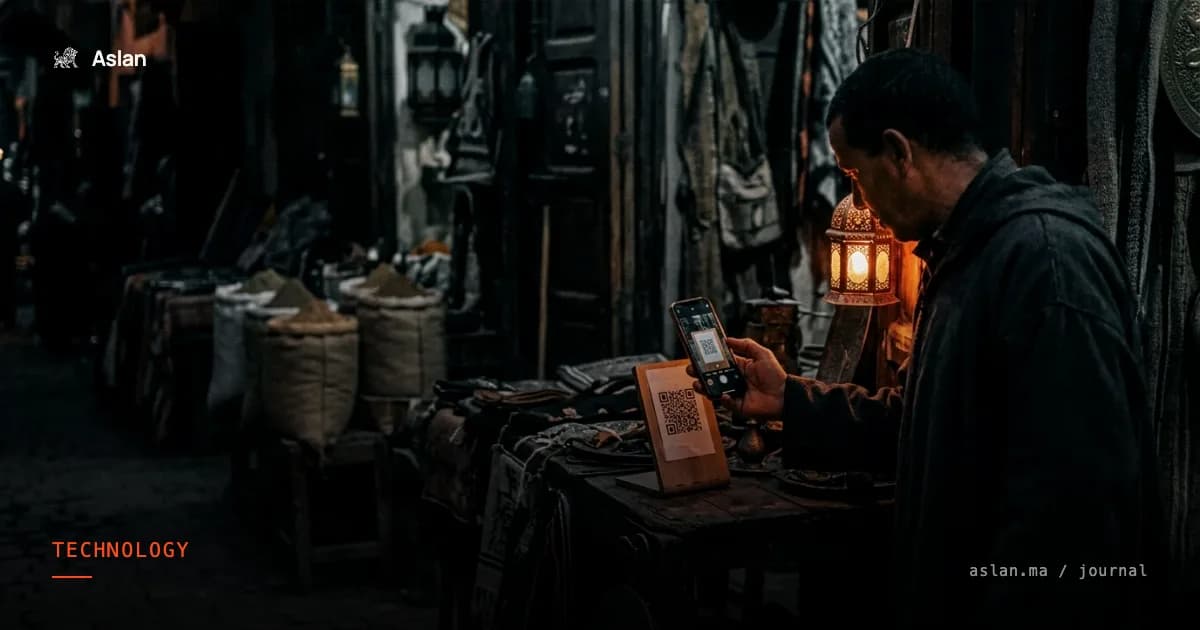
QR code payments in Morocco are experiencing explosive growth. Driven by the national financial inclusion strategy and evolving consumer habits, this payment method is establishing itself as an essential alternative to traditional POS terminals. For Moroccan merchants, it represents a major opportunity to modernize their payment collection while reducing costs.
How do QR code payments work?
The principle is simple and elegant: the merchant displays a QR code (static or dynamic), and the customer scans it with their mobile app to make the payment. Here is the process in detail:
- QR code generation: The merchant generates a QR code from their Aslan app or POS terminal. It can be static (variable amount) or dynamic (pre-filled amount).
- Customer scan: The customer opens their mobile payment app and scans the QR code with their smartphone camera.
- Amount confirmation: The amount appears on the customer's screen. For static QR codes, the customer enters the amount manually.
- Payment validation: The customer confirms the payment via PIN, fingerprint, or facial recognition.
- Instant notification: The merchant receives a real-time confirmation notification on their app or terminal.
Benefits of QR code payments for Moroccan merchants
Cost reduction
One of the most compelling arguments for QR code payments is their significantly lower cost compared with traditional solutions:
- No hardware investment: Unlike POS terminals costing 2,000 to 5,000 MAD, a printed QR code is all you need
- Lower commissions: QR transaction fees are typically 30 to 50% lower than card payments
- No maintenance: No equipment to maintain, no dedicated phone line
- No rental fees: No more monthly terminal rental costs
Universal accessibility
QR codes make accepting electronic payments accessible to everyone:
- Suitable for all businesses, from small grocers to fine dining restaurants
- Works without a permanent internet connection (offline mode available)
- Compatible with all modern smartphones
- Ideal for street vendors and traditional markets
Speed and security
QR transactions are both fast and secure:
- Transaction completed in under 5 seconds
- End-to-end data encryption
- Biometric or PIN authentication
- No sensitive data stored on the QR code itself
- Complete traceability of every transaction
Aslan's QR code solution for merchants
Aslan has built a complete QR payment solution, designed for the realities of the Moroccan market and backed by the Aslan payment gateway:
Static QR code: simplicity first
Ideal for small businesses, a static QR is a printed code that the merchant displays at the checkout. The customer scans, enters the amount, and pays. It is the simplest and most affordable solution.
Dynamic QR code: for precise transactions
Generated for each transaction, a dynamic QR includes the exact amount to pay. It eliminates input errors and speeds up the payment process. Ideal for restaurants, retail, and service providers.
Integration with Aslan POS terminal
For merchants equipped with the Aslan POS terminal (Sunmi), the QR code is generated directly on the terminal screen, combining the advantages of a smart POS and QR payments.
Merchant dashboard
Every QR transaction is instantly recorded in the Aslan dashboard:
- Complete transaction history
- Daily, weekly, and monthly sales reports
- Accounting export (CSV, PDF)
- Real-time notifications
- Footfall and average basket statistics
Comparison: QR code vs traditional POS terminal
Here is a detailed comparison to help you choose the solution that best fits your business:
- Initial cost: QR code: 0 MAD (printed for free) — POS: 2,000 to 5,000 MAD (purchase) or 100 to 200 MAD/month (rental)
- Commission per transaction: QR code: 0.5 to 1% — POS: 1.5 to 2.5%
- Setup time: QR code: immediate — POS: 1 to 3 weeks
- Maintenance: QR code: none — POS: updates, repairs
- Mobility: QR code: total — POS: limited to the point of sale
- Accepted payment types: QR code: mobile wallets, bank accounts — POS: bank cards
Combining both solutions offers the most complete coverage. That is why Aslan offers packages that include both the POS terminal and QR payments — with Aslan Omni card terminals handling card payments at the counter.
Mobile payment adoption in Morocco: key figures
Morocco is establishing itself as a regional leader in mobile payment adoption:
- Smartphone penetration: Over 80% of Moroccans own a smartphone in 2026
- M-commerce growth: Mobile commerce grew over 40% between 2024 and 2025
- National strategy: Bank Al-Maghrib has made mobile payments a priority in its 2024-2028 financial inclusion strategy
- Interoperability: The national mobile payment switch enables transactions between different operators and institutions
- Government target: Reduce cash's share in the economy from 80% to 50% by 2030
How to get started with QR code payments
Setup is quick and simple:
- Open your Aslan business account if you haven't already
- Activate the QR payment option from your merchant portal
- Receive your QR kit: Aslan sends you a kit with your personalized QR codes and a display stand
- Train your team: An in-app tutorial guides your employees
- Collect your first payments: Funds are credited instantly to your Aslan account
Use cases: who is adopting QR codes in Morocco?
- Grocery and convenience stores: Static QR codes replace cash for small everyday purchases
- Restaurants and cafés: A dynamic QR printed on the bill simplifies payment collection
- Street vendors: Fruit sellers, weekly markets — the QR code is their first digital payment tool
- Service providers: Plumbers, electricians, delivery drivers — the QR code lets them get paid immediately on site
- E-commerce and delivery: The delivery driver displays a QR code for payment on delivery
FAQ: Common questions about QR code payments in Morocco
Are QR code payments secure?
Yes, QR code payments are highly secure. Every transaction is end-to-end encrypted, and the customer must authenticate via PIN or biometrics before confirming. No sensitive data is stored on the QR code itself.
What are the fees for merchants?
With Aslan, QR payment commissions are among the most competitive on the market, typically between 0.5% and 1% per transaction, with no fixed monthly fees.
Do QR codes work without internet?
Static QR codes can be generated and displayed without a connection. However, payment validation requires an internet connection (on the customer's side). Aslan offers a deferred sync mode for areas with limited connectivity.
How long does it take to receive funds?
QR payments via Aslan are credited instantly to your Aslan account. You can then transfer funds to your bank account at any time.
Can I use a QR code and a POS terminal at the same time?
Absolutely. Aslan even encourages this hybrid approach to maximize the payment methods you accept and never miss a sale.