
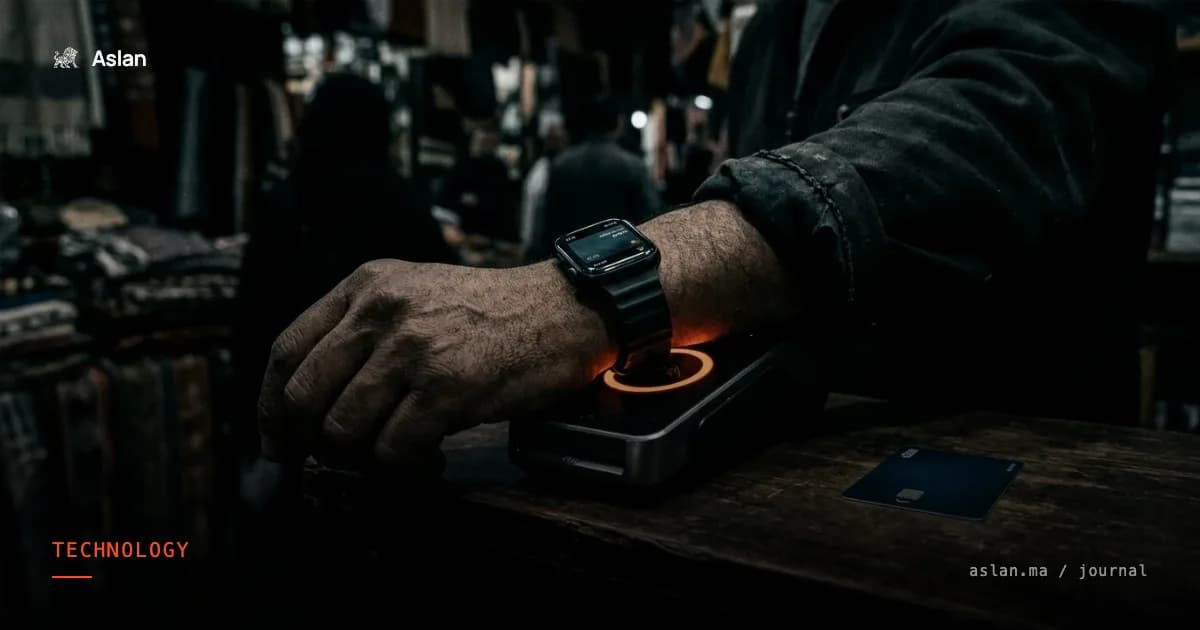
Contactless Payments: A Quiet Revolution in Morocco
Contactless payments are experiencing remarkable acceleration in Morocco. According to the latest figures from Bank Al-Maghrib, contactless transactions increased by 145% between 2024 and 2025, driven by the widespread deployment of compatible terminals and evolving post-pandemic consumer habits. In 2026, Morocco positions itself as a regional leader in North Africa for digital payment adoption.
This guide takes an in-depth look at the technologies that make contactless payment possible, their adoption in Morocco, and how merchants and consumers can get the most out of them.
How Contactless Payments Work
NFC Technology (Near Field Communication)
Contactless payment primarily relies on NFC technology, a short-range radio communication standard (less than 4 centimeters). When you bring your bank card or smartphone close to a compatible payment terminal, the two devices exchange transaction information securely and almost instantaneously.
- Frequency: 13.56 MHz, maximum range of 4 cm
- Transaction duration: less than 500 milliseconds
- Security: each transaction generates a unique cryptogram that cannot be reused
- PIN-free limit: generally set at MAD 500 in Morocco
EMV Contactless Standard
Behind NFC, the EMV Contactless protocol (developed by Europay, Mastercard, and Visa) ensures interoperability and transaction security. This standard defines how the card and terminal communicate, authenticate the transaction, and generate security cryptograms.
The main variants are:
- Visa payWave: used by contactless Visa cards
- Mastercard Contactless: for Mastercard cards
- American Express ExpressPay: less common in Morocco
Tap-to-Pay on Smartphones
Beyond physical cards, Tap-to-Pay on smartphones represents the natural evolution of contactless payment. Through mobile wallets (Apple Pay, Google Pay, Samsung Pay), your phone emulates a bank card via its built-in NFC chip.
The benefits of mobile Tap-to-Pay:
- Tokenization: the actual card number is never transmitted to the terminal
- Biometric authentication: Face ID, fingerprint, or phone PIN
- Multi-card: store multiple cards in a single wallet
- Instant history: real-time notification after each payment
Contactless Payment Adoption in Morocco
State of Play in 2026
Morocco has significantly accelerated its transition to digital payments. Here are the key figures:
- 78% of bank cards issued in Morocco are now contactless
- 65% of POS terminals accept contactless payments
- Contactless transactions exceeded 50 million per month in 2025
- The average contactless payment amount is MAD 180
Leading Sectors
Some sectors have adopted contactless payment faster than others:
- Large retail: Marjane, Carrefour, BIM — nearly all checkouts equipped
- Quick service restaurants: McDonald's, Paul, and local chains
- Gas stations: Afriquia, Shell — fast payment at the pump
- Public transport: Casablanca and Rabat tramways accept contactless
- Pharmacies: growing adoption in the major cities
Remaining Barriers
Despite this positive momentum, obstacles remain:
- Cash-dominated economy: cash still accounts for more than 50% of daily transactions
- Cost of POS terminals: the investment remains a barrier for small merchants
- Lack of trust: some consumers still fear contactless fraud
- Connectivity: in rural areas, network coverage limits adoption
Benefits for Moroccan Merchants
For merchants, contactless payment is much more than a simple upgrade. It is a lever for commercial performance.
Speed and Flow
A contactless transaction takes an average of 3 seconds, compared to 15-30 seconds for a card payment with PIN, and over a minute for a cash payment (counting, giving change). During peak hours, this difference translates to 30-40% higher checkout throughput.
Reduced Cash Handling
Less cash means less time counting, fewer errors, fewer cash-in-transit runs, and reduced theft risk. For a business with MAD 50,000 monthly revenue, cash handling can represent 2-5% of operational costs.
Higher Average Transaction Value
Studies show consumers spend on average 20-30% more when paying by card versus cash. Contactless amplifies this trend by making the payment act nearly imperceptible.
Hygiene and Brand Image
Since the pandemic, offering contactless payment has become a signal of modernity and concern for hygiene. Equipped businesses project a more professional image and attract a younger, more connected clientele.
Aslan and Contactless Payments
NFC Card Top-Up
Aslan integrates NFC technology directly into its mobile app. Users can top up their prepaid card by simply holding it near their smartphone — no branch visit or physical point of sale needed. This feature, unique in the Moroccan market, offers:
- Instant top-up 24/7
- Real-time card balance verification
- Complete top-up history
- Enhanced security via biometric authentication
QR Code Payment: The NFC Alternative
For merchants who do not yet have an NFC payment terminal, Aslan offers QR code payment. The merchant displays a static or dynamic QR code that the customer scans with the Aslan app for instant payment.
The advantage of this solution is that it requires zero hardware investment on the merchant side — a simple printed QR code is enough. For more on merchant payment solutions, read our guide on online payments in Morocco.
Contactless vs Cash: The Comparison for Morocco
| Criterion | Cash | Contactless |
|---|---|---|
| Speed | 60+ seconds | 3 seconds |
| Cost for the merchant | 2-5% (handling) | 0.5-1.5% (commission) |
| Traceability | None | Complete |
| Fraud risk | Counterfeit notes | Very low (tokenization) |
| Rural accessibility | Universal | Growing |
| Financial inclusion | Limits | Encourages |
Contactless Payment Security: Myths and Realities
Myth: "Someone can steal money by approaching a terminal to my pocket"
Reality: For a transaction to occur, the terminal must be activated by the merchant with a defined amount, and the card must be within 4 cm. In addition, each transaction generates a unique cryptogram. Proximity fraud risk is virtually nonexistent.
Myth: "Contactless is not secure"
Reality: Contactless payments use the same EMV security protocols as chip-and-PIN. Smartphone tokenization adds an extra security layer, making mobile Tap-to-Pay more secure than a traditional card payment.
Security Best Practices
- Turn on real-time notifications in your banking app
- Check your account statements regularly
- Use an anti-RFID wallet if you wish (extra protection)
- Report any suspicious transaction to your bank immediately
The Future of Contactless Payments in Morocco
Trends to Watch
- SoftPOS: Turning any Android smartphone into a payment terminal with no extra hardware. Aslan is exploring this technology for micro-merchants
- Wearable payments: Smartwatches, NFC rings — payment beyond the phone
- Integrated transport: Pay for buses, trams, and parking with a simple card or phone
- Open Banking: Open banking APIs will enable even smoother payment experiences
- Biometrics: Facial or palm recognition payment, already tested in other markets
Bank Al-Maghrib's Vision
Morocco's central bank has set ambitious targets for the digitalization of payments. The national strategy aims to reduce cash to less than 40% of transactions by 2028, with contactless as the main lever. Tax incentives to help merchants equip themselves with POS terminals are being rolled out.
FAQ: Contactless Payments in Morocco
What is the contactless payment limit in Morocco?
The PIN-free contactless payment limit is generally set at MAD 500 per transaction. Above that, PIN entry is required. This limit may vary from one bank to another.
Is my Moroccan bank card contactless-compatible?
If your card displays the wave symbol (four arcs), it is contactless-compatible. Most cards issued in Morocco since 2022 include this feature.
Is contactless payment available everywhere in Morocco?
Adoption is concentrated in major cities (Casablanca, Rabat, Marrakech, Tangier, Fez) and large retail chains. Rural areas are being progressively equipped.
Can I use Apple Pay or Google Pay in Morocco?
International wallet availability is expanding in Morocco. Some banks already support them, while others offer their own mobile wallets. Aslan enables NFC top-up directly from its app.
How can a merchant accept contactless payments?
Merchants need an NFC-compatible terminal, offered by banks and payment providers — for example an Aslan Omni card payment terminal. Alternatively, QR code payment solutions like Aslan's require no special equipment.
Does contactless work without an internet connection?
The payment terminal needs a connection (4G, Wi-Fi, or wired) to authorize the transaction. However, some terminals support an offline mode for a limited number of low-value transactions, which are synchronized afterwards.